Book available now
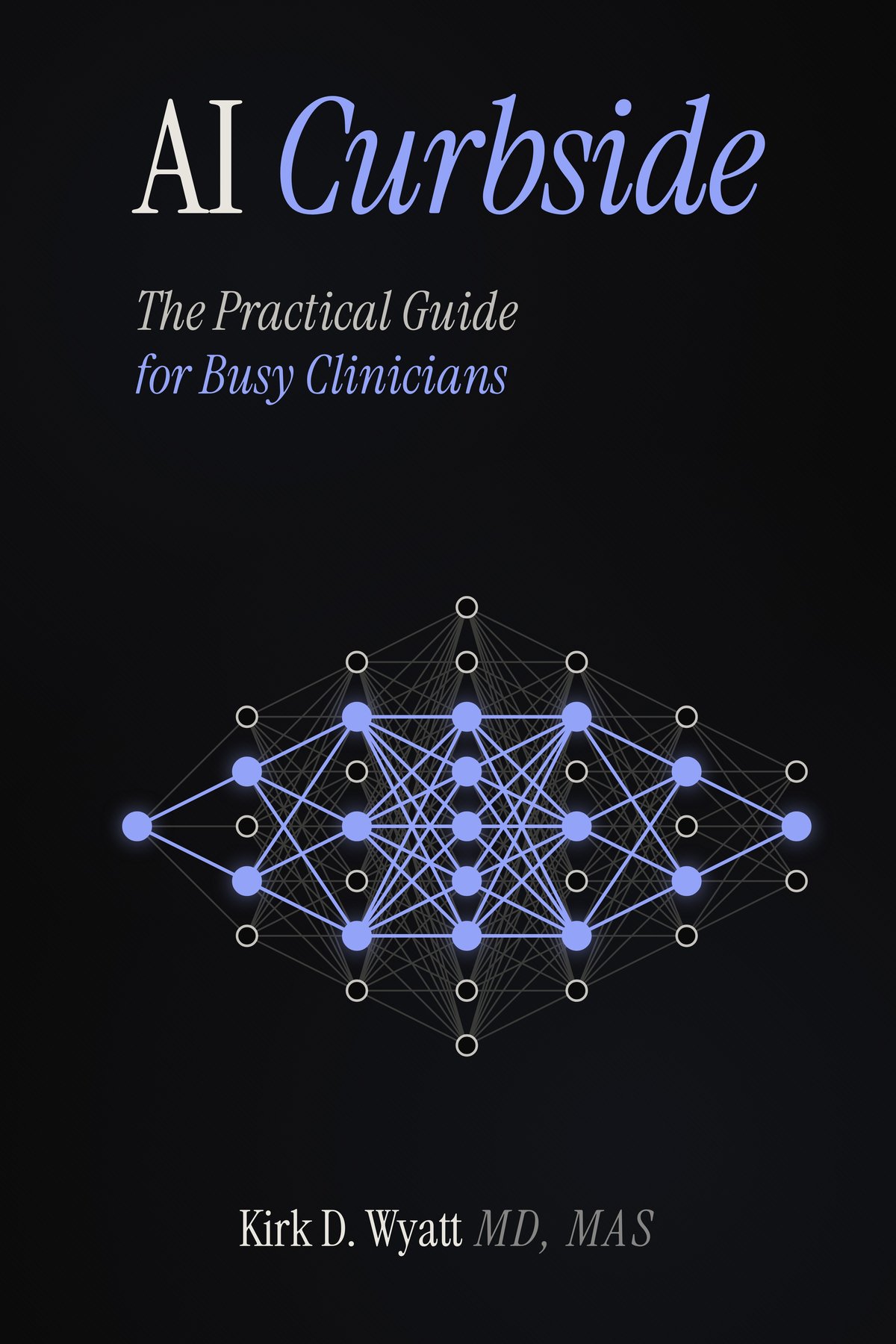
AI Curbside: The Practical Guide for Busy Clinicians, by Kirk D. Wyatt, MD, MAS
Read a sample →

A brief field guide that helps trainees and physicians of all specialties decode the jargon, cut through the hype, and start using artificial intelligence effectively — starting now.

Available now

Amazon Kindle eBook Barnes & Noble Nook eBook & Audiobook Kobo eBook Libby Library eBook

Coming soon

Hardcover, paperback, and audiobook editions are on the way at additional retailers.

Amazon Hardcover & Paperback
Barnes & Noble Hardcover & Paperback
Audible Audiobook
Apple Books eBook
Google Play eBook & Audiobook
Spotify Audiobook
ElevenReader Audiobook

Ask your librarian

Want to read it through your local library? Most libraries take patron requests — ask them to add it on Libby, Hoopla, or in print. Pass these details to your librarian:

LCCN
2026910640
ISBN (eBook)
979-8-9958402-4-4
ISBN (Hardcover)
979-8-9958402-0-6
ISBN (Paperback)
979-8-9958402-1-3
ISBN (Audiobook)
979-8-9958402-3-7

AI is here. Your peers are using it. Are you?

Whether you're a skeptic or an early adopter, AI is already shaping how medicine is practiced. This book gives you the foundation to use AI on your terms.

Read it on a Sunday afternoon. Use it on Monday morning.

A three-hour read that decodes the jargon. No computer science prerequisites. Just practical guidance written by a practicing physician who uses these tools every day.

Stay relevant. Stay capable. Save time.

AI won't replace you — but you'll be outpaced if you're not using it as effectively as your peers. Get the practical playbook built for you.

You wouldn't practice without evidence.
Don't use AI without understanding it.

Understand how these tools work under the hood. Learn the guardrails and how to pick the right tool for each job. This book covers everything you need to know to use AI responsibly and effectively.

No computer science degree required. Just curiosity.

Tokens, embeddings, RAG, temperature — all of the jargon decoded and explained in plain English. Anyone can read this book and understand how AI works.

If an AI tool saves you 30 minutes a week, it's already paid for itself.

Learn which tools to invest in, how to use them, and do the $5 experiment that will reshape how you view the capabilities of AI.

What You'll Learn

Part I

Getting Started

Why AI matters now, how to talk to it effectively, and the privacy and security guardrails you need from day one.

Part II

How AI Works

Just enough under the hood to drive safely — embeddings, tokens, context windows, and hallucinations explained in plain English.

Part III

Your AI Cockpit

A hands-on tour of real tools — including the ones you've heard of and many you probably haven't. Try the $5 lab experiment that will open your eyes to what AI can really do.

Part IV

Safety, Security & Accountability

How AI can hurt patients, hallucinated citations, shadow IT, and the practical security considerations every clinician needs to understand.

Part V

The Playbook

Practical use cases and implementation guide for bedside clinicians, researchers, and the C-suite.

Part VI

The Future

Where AI in healthcare is heading — staying current, filtering out the hype, and keeping your critical thinking sharp.

About the Author

Kirk D. Wyatt, MD, MAS is a board-certified Pediatric Hematologist/Oncologist and Clinical Informatician practicing in Fargo, North Dakota at Sanford Health. He is board-certified in Pediatrics, Pediatric Hematology/Oncology, and Clinical Informatics. His research focuses on leveraging data science and AI to improve pediatric cancer care through his work with Data for the Common Good at the University of Chicago. He trained at Mayo Clinic and holds a Doctor of Medicine from Mayo Clinic Alix School of Medicine and a Master in Advanced Study in Health Informatics from Arizona State University.

Kirk has published extensively on clinical informatics, AI in healthcare, and pediatric oncology data standards. His 2020 Apple Watch research was covered by The Verge, USA Today, Politico, CNET, Fast Company, Becker's Hospital Review, Detroit Free Press, MobiHealthNews, The Telegraph, and Daily Mail, and was featured on the Wall Street Journal's flagship podcast The Journal. The New England Journal of Medicine published a related letter on smartwatch atrial fibrillation detection.

Full bio and publications →